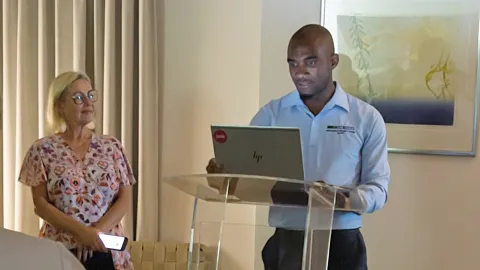
Speech by Frederico Cossa
To the participants at the reseption, including Ambassador of Finland in Mozambique, Mr. National Director of Secondary Education, representatives of the Jamk University of Applied Sciences and the University of Lapland, Cossa's colleagues from the Pedagogical University of Maputo and the Higher Institute of Education and Technology – One World, members of the Diplomatic Mission of Finland.
It is for me on behalf of the Pedagogical University of Maputo and the Higher Institute of Education and Technology - One World, an honor and, at the same time, a great pleasure to speak on this solemn occasion of fraternal gathering, in this house that symbolizes the friendship between Mozambique and Finland. I would like to thank, first and foremost, Her Excellency the Ambassador for her hospitality and for the initiative of hosting this reception ceremony, which, more than a formality, is an opportunity to strengthen ties of cooperation around a cause we share: inclusive education.
Ladies and gentlemen, Inclusive education is not just a modern concept, but a fundamental human right, enshrined in the Constitution of the Republic of Mozambique. It reaffirms the principle that all citizens, regardless of their physical, social, economic, cultural, or linguistic background, should have access to quality education. Our country has made this commitment not only at the constitutional level, but also through the Ministry of Education's Strategic Plans, which clearly highlight the need to make the education system more inclusive, fairer, and better adapted to the diversity of our realities.
Dear guests, we know that teachers are the central element of any educational reform. Improving the quality and relevance of teacher training programs essentially means strengthening pedagogical practices, making them more inclusive and more aligned with the practical realities of Mozambican educational contexts.
The challenge we face is great:
- Many teachers have not yet benefited from updated methodologies on inclusive education.
- The Mozambican classroom is, by nature, diverse — linguistically, culturally and socially.
- The children and young people who attend our schools today need teachers who are prepared to deal with differences, transforming diversity into a pedagogical asset rather than an obstacle.
The international collaboration we celebrate today is, therefore, a concrete response to this challenge. Let me highlight three fundamental dimensions of this joint initiative:
- The Dimension Academic and Curricular
Our commitment is to work towards reviewing and updating teacher training programs, incorporating inclusive practices that allow future educators to understand and respond to the needs of all students. This involves integrating content into the curriculum related to diversity, gender equity, the inclusion of students with special educational needs and respect for the multiculturalism that characterizes Mozambique.
- The Dimension Pedagogical and Practical
Teacher training must be more focused on the practical realities of schools . This means strengthening teaching internships, supervised internships, and direct links between training institutions and secondary schools. By learning by doing, future teachers not only acquire knowledge, but also develop skills to face the challenges of everyday school life.
- The Dimension Institutional and Strategic
The Pedagogical University of Maputo and the Higher Institute of Education and Technology - One World , in coordination with the Ministry of Education, are committed to aligning this cooperation with national strategic plans , in order to ensure that the actions developed are not just one-off experiences, but rather lasting contributions to the education system.
Your Excellency Ambassador, Ladies and Gentlemen,
by embracing this partnership with Finnish institutions, we are not just exchanging methodologies. We are building a shared vision of education, based on universal values of inclusion, equity, and quality.
Finland's experience is inspiring, as it shows us that high standards of learning can be achieved when teachers are valued, active student participation is encouraged, and schools become places of belonging for all.
Mozambique, with its vibrant and resilient youth, deserves this investment. We believe that every child, regardless of their birthplace, language, or living conditions, has the potential to learn and contribute to the country's development.
Let me conclude on a note of optimism and shared responsibility.
We are here tonight, united by the same purpose: to improve the quality of education in Mozambique through inclusive practices . This is a commitment that requires vision, cooperation, and perseverance. It also requires that each of our institutions assume its role - whether in curriculum design, practical training, research, or public policymaking.
Dear Ambassador, Dear National Director, Dear Partners, on behalf of the Mozambican institutions represented here, please accept our gratitude and our commitment to continue working side by side so that inclusive education in Mozambique is not just an ideal, but a concrete reality in every school, every classroom, and every community. Thank you very much for your attention!