Six student teams, representing agrology, chemical engineering, electrical and automation engineering, and energy and environmental engineering took part to the competition. Business expertise was provided by Biopallo Systems, Sitowise and UOMA.
To address the complex challenge, teams proposed solutions ranging from digital platforms to refining side streams into growing media and even cement.
Tuomas Pussila, Head of the Circular Economy Centre at Kemi Digipolis, which commissioned the hackathon and also took part in mentoring, was pleased with the outcome:
“There was a remarkably wide range of high-quality ideas. I learned new things myself, and above all, it was refreshing to see the new ways of thinking that young people bring to these challenges.”
Two student teams among the top three – winning concept developed by electrical engineering students
Third place went to Click Clack, a team of chemical engineering students from Aalto University. Their concrete concept focuses on refining industrial side streams into new products while improving regional water quality.
Second place was awarded to Biopallo Systems for its service model, which enables the on-site processing of forest industry side streams into products with a higher value.
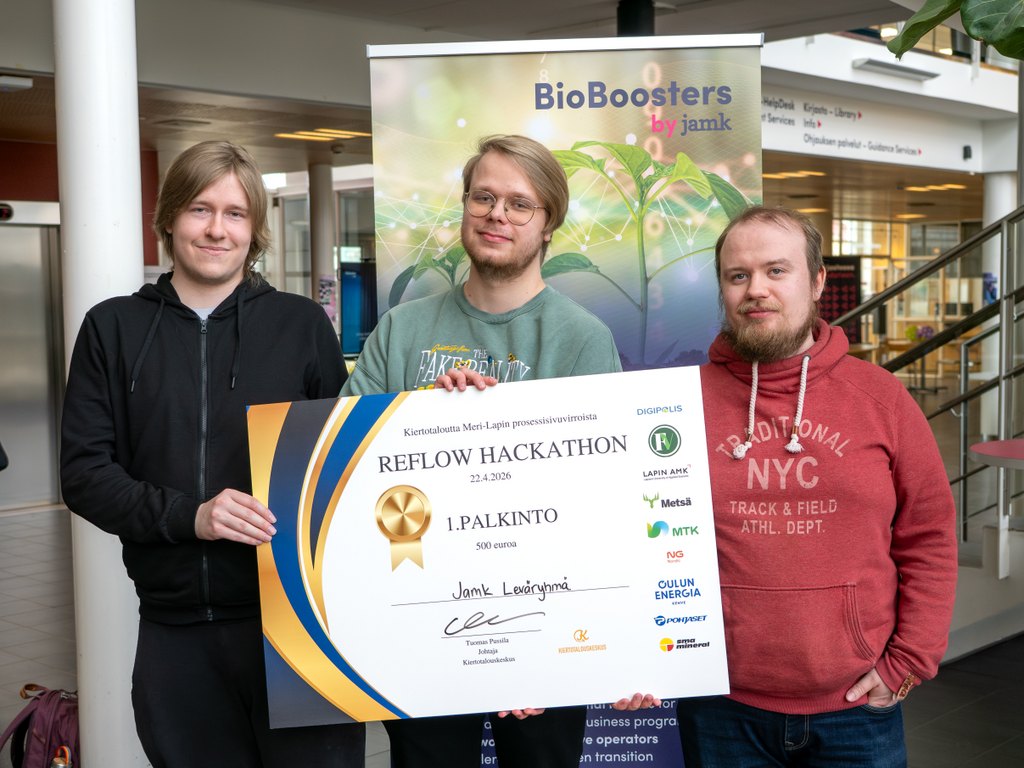
The winners were Jamk Leväryhmä, a team of electrical and automation engineering students. They presented a concept for cultivating microalgae by utilising various side streams and waste heat, and also proposed a wide range of potential applications for microalgae.
According to the team, their participation was inspired by a carbon-related project (HiHaCO2), where team member Jesse Suvinen is currently completing his internship. However, they describe joining the competition as almost accidental.
“As engineers, the very first thing we had to do was find out what a side stream actually is,” Suvinen admits. “Winning feels great. The hackathon gave us hands-on experience in designing and delivering a pitch, which was still quite new to us. It is also a valuable addition to a student’s CV. The topic will be further explored in the HiHa project, where I will continue my internship.”
“We were impressed by how much added value microalgae can create, not only in the utilisation of side streams but also as a source of revenue across different business areas,” says Pussila, describing the judging criteria.
Reetta Anderson, Head of Research and Development at NG Nordic, who followed the event on site, was also pleased with the outcome: “It was inspiring to take part in the ReFlow Hackathon and hear such well-prepared pitches. We will certainly continue to follow the most interesting teams and ideas and aim to support their further development where possible.”
“This competition demonstrated the need for open innovation challenges like this. Looking beyond traditional boundaries can lead to surprising and fresh ideas,” Pussila summarises.
The hackathon was organised by the Circular Economy Centre as part of a broader project in the Meri-Lappi region. The project also involves a wide range of process industry companies operating in the area, including NG Nordic, Metsä Group and SMA Minerals.